Amsterdam, Netherlands - June 10, 2026:
Brighter Signals today announced the launch of its next-generation
Seat-Belt Reminder (SBR) sensor, building on the global momentum of its occupancy classification platform now in active evaluation with leading OEMs and Tier 1s. The new SBR sensor is a deliberately simpler, lower-cost product engineered as a
direct, rolling-change replacementfor today’s 2-pin SBR sensors — no ECU redesign, no harness change, no integration project. It delivers a meaningful step-up in accuracy at the same price point as the binary presence detectors that have dominated the SBR category for nearly twenty years.
The new sensor addresses a less-discussed but serious safety gap: legacy SBR sensors frequently miss children, teenagers, and small adults who aren’t sitting squarely on the seat — meaning the system fails to remind exactly the occupants who most need to be belted. Brighter Signals’ improved accuracy and larger sensing area are designed to close that gap.
Several active proof-of-concept programs with global OEMs are already underway, focused on the well-documented limitations of legacy SBR technology — missed detection of small or off-center occupants, false chimes triggered by groceries, backpacks, or handbags, and the inability of single-threshold sensors to reliably tell a seated person apart from a piece of cargo.
THE PROBLEM
Why this matters: the SBR category hasn’t advanced in two decades
Today’s seat-belt reminder systems are built on technology that has barely evolved since the early 2000s. Most are simple bend-sensors or single-zone pressure sensors that report a binary “weight present / weight absent” signal to the seat ECU. The result, as documented by automakers and consumer complaints worldwide, is a sensor that:
- Fails to reliably detect children, teenagers, and small adults who don’t sit squarely on the seat — exactly the occupants the system is meant to remind
- Loses detection of small occupants during cornering, when the rider shifts away from the sensor’s single zone
- Chimes when a bag of groceries, a backpack, or a purse is placed on the seat
- Cannot reliably tell the difference between a seated occupant and cargo of similar weight
- Suffers from hot-spot wear, drift, and edge-of-sensor failures over the life of the vehicle
- Generates enough false alerts that owners actively look for ways to defeat the system — undermining the safety intent of the regulation in the first place
These limitations are not edge cases. They are daily occurrences across the global fleet and a known source of warranty cost, customer complaints, and regulatory risk.
THE PRODUCT
How the Brighter Signals SBR sensor is different
The new sensor is a focused, single-purpose product — it isnot a full occupancy classification system. It does not classify occupants by weight class, detect out-of-position seating, or distinguish child seats. What it does is capture richer, spatially distributed weight and weight-distribution data than a binary sensor can provide, and use that data to make a substantially more accurate belted/unbelted decision:
- Weight distribution, not just weight.
Where a legacy SBR sensor reports a single threshold crossing, the Brighter Signals sensor reads how load is distributed across the seating surface. A seated human body produces a characteristic distribution pattern that a backpack, a bag of groceries, or a box does not — and that difference is what the SBR logic keys on.
- Reliable detection of small occupants.
The larger sensing footprint and richer distribution data are designed to recognize children, teenagers, and small adults even when they aren’t seated squarely — closing a well-known coverage gap in legacy SBR sensors and addressing a known safety shortfall.
- Cornering-tolerant.Because the sensor reads a far greater surface area, an occupant is recognized even as they shift during cornering or lean against the door — conditions under which legacy single-zone sensors can lose detection.
- Whole-surface sensing.
The fabric sensor covers the full cushion area rather than a single zone, so an occupant is recognized whether they sit centered, shifted, or with crossed legs — and a bag pressed against one edge of the seat is far less likely to be misread as a person.
- Drop-in electrical compatibility.
The sensor interfaces with existing 2-pin seat ECUs without modification. OEMs can specify it on a current platform without re-architecting the seat electronics, requalifying the harness, or changing software in the body control module.
- Cost-neutral.
The new SBR sensor is priced to compete head-to-head with incumbent binary sensors, removing the traditional cost-versus-performance trade-off that has kept the category stagnant.
- Durable.
The fabric construction has no moving parts and no localized pressure points, and is designed to perform consistently over the service life of the vehicle.
FROM THE TEAM
Andrew Klein, Co-Founder and CEO of Brighter Signals, said:
“SBR is one of the most-complained-about systems in the modern vehicle, and the technology underneath it hasn’t meaningfully changed in twenty years. OEMs have to balance customer satisfaction with regulatory compliance — safety always comes first, but cost matters too — and until now that meant living with false chimes and conservative calibrations, because the only alternative was a much more expensive and more complicated sensor system. We’ve removed that trade-off. Our SBR sensor slots directly into the existing 2-pin ECU footprint, costs no more than the binary sensor it replaces, and brings a meaningful step-up in accuracy. For an OEM, this is the rarest kind of upgrade — better performance, same cost, no integration project.”
Edward Shim, Co-Founder and CTO of Brighter Signals, who invented the underlying sensor technology, added:
“The fundamental problem with legacy SBR sensors is that they are trying to infer a human being from a single number — typically whether weight on the seat crosses a threshold — and a single number simply isn’t enough information to tell a small adult from a backpack of similar weight, or to recognize a child who isn’t sitting squarely on the seat. Our fabric sensor doesn’t try to do occupant classification at the SBR level — that’s a different productr. What it does is capture enough additional information about how weight is applied and distributed across the seating surface to make the binary belted/unbelted decision much more reliably. The active POCs we’re running with OEMs are focused on exactly that: showing that the false alarms which define the current generation of SBR sensors can be substantially reduced — and the small occupants those sensors miss today can be reliably detected — without changing the ECU, the harness, or the price.”
PRODUCT FAMILY
Relationship to the Brighter Signals occupancy classification platform
The new SBR sensor shares the same underlying fabric-sensor substrate as the company’s occupancy classification (OC) system but is a distinct, simpler product with a narrower job. The OC system uses a richer sensor configuration — multiple pressure sensors, capacitance sensing, and seat-back proximity strips — together with a classification algorithm to support airbag-deployment decisions under FMVSS 208, Euro NCAP, and UN R94/95. The SBR sensor does none of that. It is designed to do one thing well — improve the belted/unbelted decision at the same cost and pin-count as today’s binary sensors — and to give OEMs a path to better SBR performance without committing to a full OC program.
AVAILABILITY
Availability and partner engagement
The Brighter Signals SBR sensor is available now for OEM and Tier 1 evaluation, with active proof-of-concept programs underway with multiple global vehicle manufacturers. The sensor is suitable for new vehicle programs as well as rolling-change upgrades on platforms already in production, where SBR performance complaints or regulatory pressure are driving a sensor change. Through its manufacturing partnership with Changshu, China-based CAIP Ltd, production is scalable to global OEM volumes under established automotive quality standards.
ABOUT BRIGHTER SIGNALS
Brighter Signals develops fabric-based sensor technology for the automotive industry, enabling occupant detection, classification, position sensing, and seat-belt reminder applications. The company’s patented platform measures weight, pressure, and proximity through voltage and capacitance differentials in fabric-integrated sensors, delivering regulatory-grade performance at a fraction of the cost, weight, and complexity of legacy systems. Headquartered in Amsterdam, Brighter Signals works with global OEMs and Tier 1 suppliers across automotive, robotics, and healthcare.
https://mailchi.mp/53ff35718669/brighter-signals-announces-further-funding-19887919?e=ca541d771e
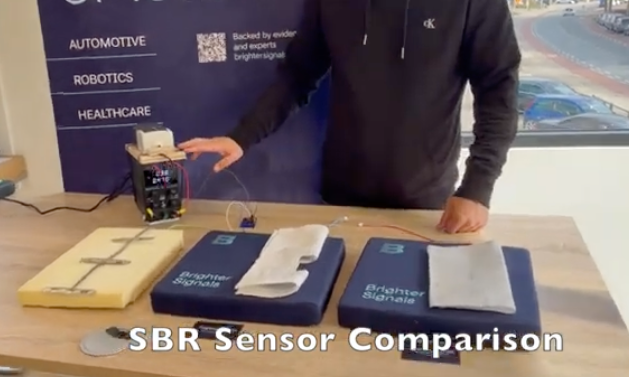
Watch the SBR sensor in action:
youtube.com/watch?v=G42Xdhv25vc
Media Contact
Brighter Signals B.V.
info@brightersignals.com
+31-6-23660310
http://www.brightersignals.com